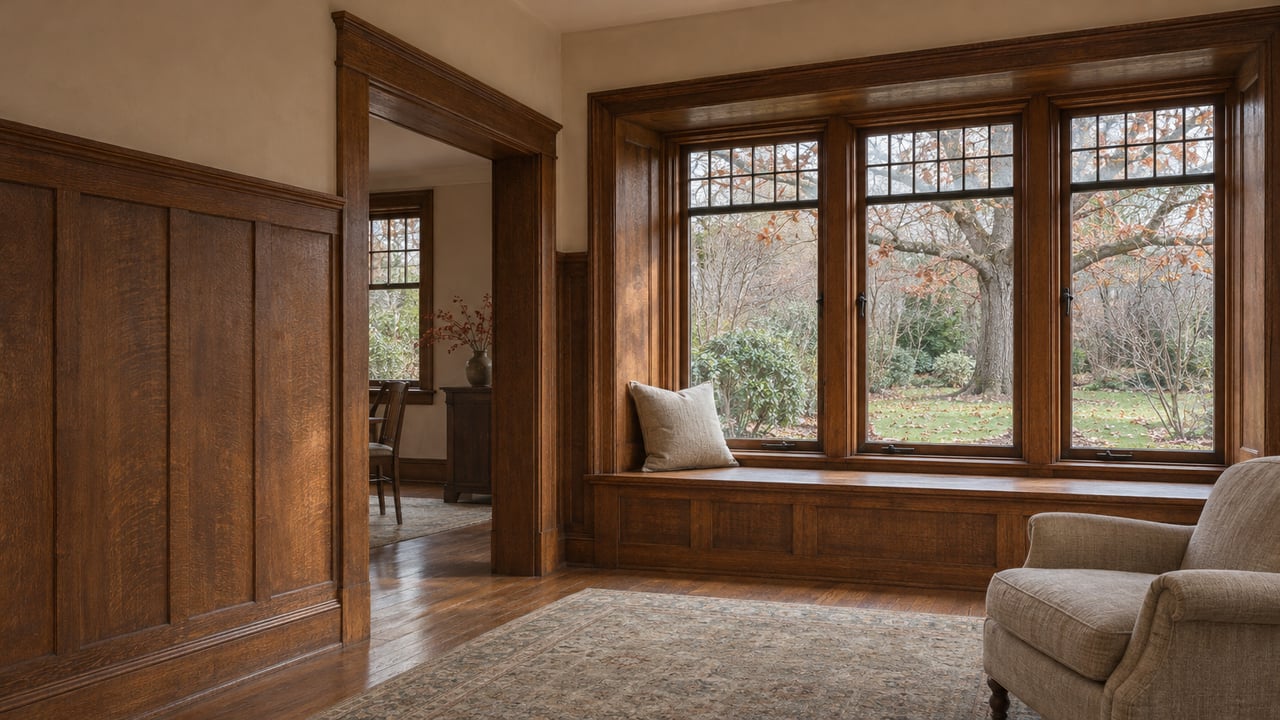
On September 21, the Village of Hinsdale issued a $40,000 fire-suppression permit for 142 E. First Street. Until late 2025 that address held the 1869 William Whitney House, also known as the Hallmark House. It stood at the entrance to the Robbins Park Historic District. In September 2025, both the Historic Preservation Commission and the Village Board voted unanimously against tearing it down. A year later the permits filed there are for a new house.
If you're weighing an older Hinsdale home, whether you're buying it or selling it, that sequence matters. Hinsdale can't say no to a teardown. It can make keeping the house the bigger, cheaper and faster option. The village does that mostly with square footage, and the cash plays a smaller part.
A unanimous no that didn't stop the demolition
As The Hinsdalean reported in September 2025, Grace Episcopal Church had owned the Italianate home since the early 1990s. It sold the house to a builder who planned a 6,841-square-foot "transitional French country" home with a four-car garage, designed to meet every zoning requirement. Trustees followed the commission and voted no. The paper noted that both votes were advisory, "meaning the owner can continue with the demolition and new construction."
Patch reported that the builder told a trade publication the village could only advise. Patch also wrote that "For years, the village has said its rules cannot ultimately stop a developer from demolishing and replacing a house as long as the new one is code-compliant." A Hinsdalean editorial in October 2025 said demolition crews were scheduled that week. By May 2026, the paper wrote that the house was gone and a replacement was being built.
The code says the same thing. In Robbins Park, a certificate of appropriateness has to come before demolition and new-home permits, but the commission's and board's final decisions are "advisory only."
What the teardown path costs in permits
If the review process can't stop a demolition, could the fees discourage one? Here is what Hinsdale's permit fee schedule and related code charge on the demolition-and-rebuild path:
- Demolition permit: $9,756 for a principal structure, or $11,715 in the Robbins Historic District, plus plan review.
- Plan review: $110 an hour for in-house review, with a one-hour minimum. Tree plan review by the village arborist costs $207.
- New-home permit: $1.45 per square foot of total floor area. Basements, attics and garages all count. At that rate, a house with 6,000 square feet across all of those spaces pays $8,700.
- Site-management bond: $3,000 in cash for a dwelling demolition or new dwelling permit.
- Site conditions: a tree-preservation plan, a six-foot chain-link security fence, protective fencing around parkway trees, and daily cleanup of debris and streets.
- A replacement plan up front: anyone demolishing a principal structure must submit plans for the new building. If construction won't start within 60 days of demolition, they also need a site-restoration plan.
Robbins Park adds a step at the front. Before a formal application, there's a preliminary design-review meeting. The review team meets within 30 days and sends written recommendations within 15 days.
All of that costs a few tens of thousands of dollars and some calendar time. For a buyer who has already paid for the lot, that isn't enough to change the decision. The real deterrent is in the zoning code.
The bigger lever is square footage
Hinsdale's Historically Significant Structures Property List, or HSSPL, launched in 2023. A home on the list in the R-1 through R-4 districts can apply for alternative bulk regulations that a new build can't use. A replacement house has to follow the underlying district's normal rules. A listed house that gets approval follows Table 8-1.
| Rule | Demolish and rebuild | Listed home using Table 8-1 |
|---|---|---|
| Floor area ratio | Base district limit applies | Not applicable |
| Maximum height | Base district limit applies | Not applicable, but no higher than the highest existing ridge line |
| Interior side yards | Base district setbacks | 10 feet in R-1/R-2, 6 feet in R-3/R-4 |
| Building coverage | Base district limit | Up to 25% of lot area combined |
| Total lot coverage | Base district limit | Up to 60%, if there are no adverse impacts on adjacent properties |
| Approval route | Standard permits plus advisory review in Robbins Park | Preservation Incentive Certificate, granted in place of the full variation process |
The village's incentives page describes it in plain terms. An owner building an addition may qualify for bulk rules "that they otherwise would not be able to take advantage of if pursuing demolition and new construction." Trustee Alexis Braden, who is also president of the Hinsdale Historical Society, put it more simply in The Hinsdalean's May 2026 report:
"We're going to allow you to build bigger on your lot than if you tore down. I think that that can be appealing, especially for younger families who need more space."
The cash incentives are real but small next to that. A matching grant covers 50% of eligible costs, up to $10,000 per project, with a $20,000 minimum investment. A property tax rebate returns the village portion of the bill for up to five years after at least $50,000 of eligible exterior work. In the village's own example, a $2,500 village share comes to about $12,500 over five years. Across the whole program, The Hinsdalean counted almost $246,000 in fee waivers, $160,000 in grants and $137,000 in property tax rebates approved, against more than $12 million in new construction.
One Tudor on Washington Street, from listing to permit
The program moves faster than most people expect. Here is how it went for 633 S. Washington Street, a 1920s Tudor Revival designed by Ralph R. Mooney:
- June 30, 2026: the Village Board added the home to the HSSPL.
- July 1: the Historic Preservation Commission approved a permit fee waiver and expedited processing. It also recommended a tax rebate and matching grant for a rear addition with a mudroom, laundry, powder room and first-floor primary suite.
- July 21: trustees heard the request. The project was an approximately 460-square-foot rear addition costing about $140,000, eligible for a $10,000 grant and an estimated $5,900 in village property tax relief over five years.
- August 24: the Board approved the incentive.
- September 17: the village issued the addition and remodel permit.
That's less than three months from joining the list to holding a building permit. A 1920s house got a modern first-floor suite without anyone filing a demolition application.
Why some homes join the list while they're for sale
Village Planner Bethany Salmon told The Hinsdalean that the best outcomes start with an early call to the village, and that "A lot of these homes got on the list when they were actually being marketed for sale." She said approval by the commission and board takes about three months.
For a seller, that changes what's being sold. An older house on a valuable lot often gets marketed to builders as a teardown. A listed house can be marketed to buyers as a home that can grow beyond what a rebuild on the same lot would be allowed. The village also says tax rebate benefits "may be transferred to subsequent property owners."
Listing comes with a few conditions. A property has to sit inside the Historic Overlay District and meet at least one significance criterion. It goes through a public hearing, and a notice is recorded against the title. The village's application packet says the property owner makes the incentive application, or a tenant does with the owner's written authorization. This post is general information, not legal, tax or zoning advice. If you're thinking about the list or an incentive for a specific property, confirm the details with the village and your own attorney or tax professional.
The district's status is part of what you're buying
The list has grown steadily. In its first three years and two months, 102 homes were added. Three of them were later removed because they were demolished: 505 S. County Line Road, 114 S. Stough Street and 142 E. First Street. Eight more addresses were proposed as Round 13 for the commission's October 19 special meeting: 7 W. Ayres St., 120 S. Elm St., 218 E. Hickory St., 730 S. Lincoln St., 108 Minneola St., 425 S. Monroe St., 427 N. Vine St. and 404 N. Washington St.
Demolitions are still being approved too. At its April 1 meeting, the commission voted 5-0 to approve demolition of a circa-1910 Colonial Revival at 305 S. Garfield and a modern replacement. During that hearing, commission chair John Bohnen asked whether Robbins Park could lose its place on the National Register, a listing it has held since 2008. As The Hinsdalean reported, Bohnen said, "Many of us are concerned that, at some point in time, we're going to lose the designation as a historic district, because there's going to be very little left that emulates historic architecture." Landmarks Illinois raised the same concern in its September 2025 letter about 142 E. First, according to Patch, and urged the village to make its demolition decisions binding.
Under the current code, those decisions are still advisory, so a restored house on the list can still end up next door to a new build like the one going up at 142 E. First.
Quick answers
Does being on the HSSPL stop a future owner from demolishing the house? No. The code's demolition review in Robbins Park is advisory, and the three demolished homes removed from the list show it.
Do the bigger zoning allowances apply automatically once a home is listed? No. The alternative bulk rules apply only after an application, compliance with program requirements and approval of a Preservation Incentive Certificate.
Are the incentives only for big additions? No. Salmon told The Hinsdalean that one owner at 518 S. Garfield Ave. used the program to help replace a leaking 100-year-old slate roof.
If you own an older Hinsdale home and the first offers are coming from builders, I'd like to help you price it both ways: as a teardown lot, and as a listed house with room to grow. At The Casselyn Group, I'll walk you through the HSSPL timeline alongside your sale timeline so you know which buyers you're marketing to before your home goes live. Start with an Instant Home Valuation, and we'll take it from there.


